The 5-Year Plan: How I Create Mine For Daily Planning
I used to hate the phrase “5-year plan.”
It felt like something you were supposed to have figured out by 25 — a neat little answer to pull out at dinner parties or job interviews. But the truth? Every time I tried to write one, I’d either go completely blank or produce something so vague and uninspiring that I forgot about it by the following week.
“I want to be successful.”
“I want to feel happy and financially stable.”
Cool. Super useful. Absolutely nothing to act on.
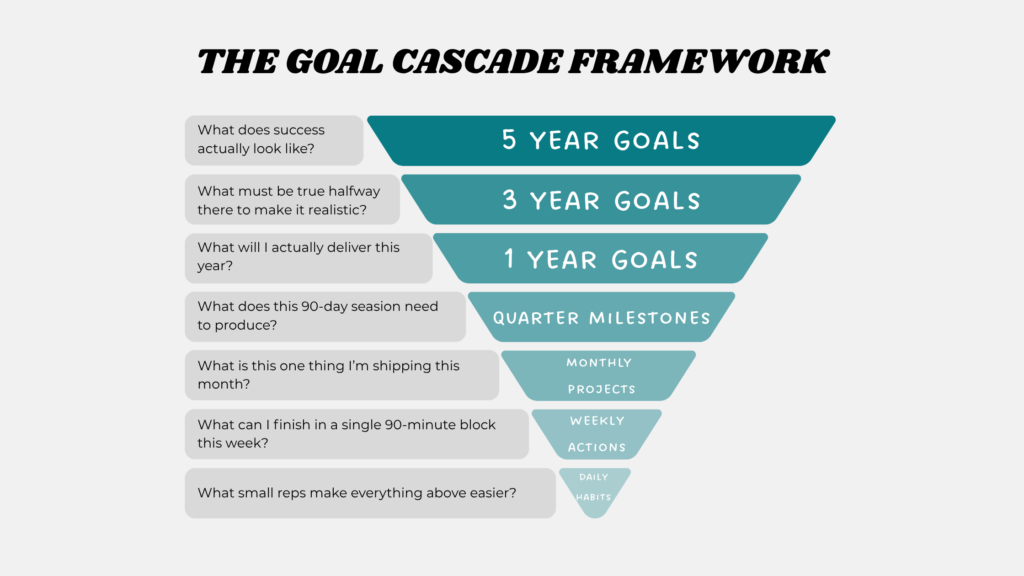
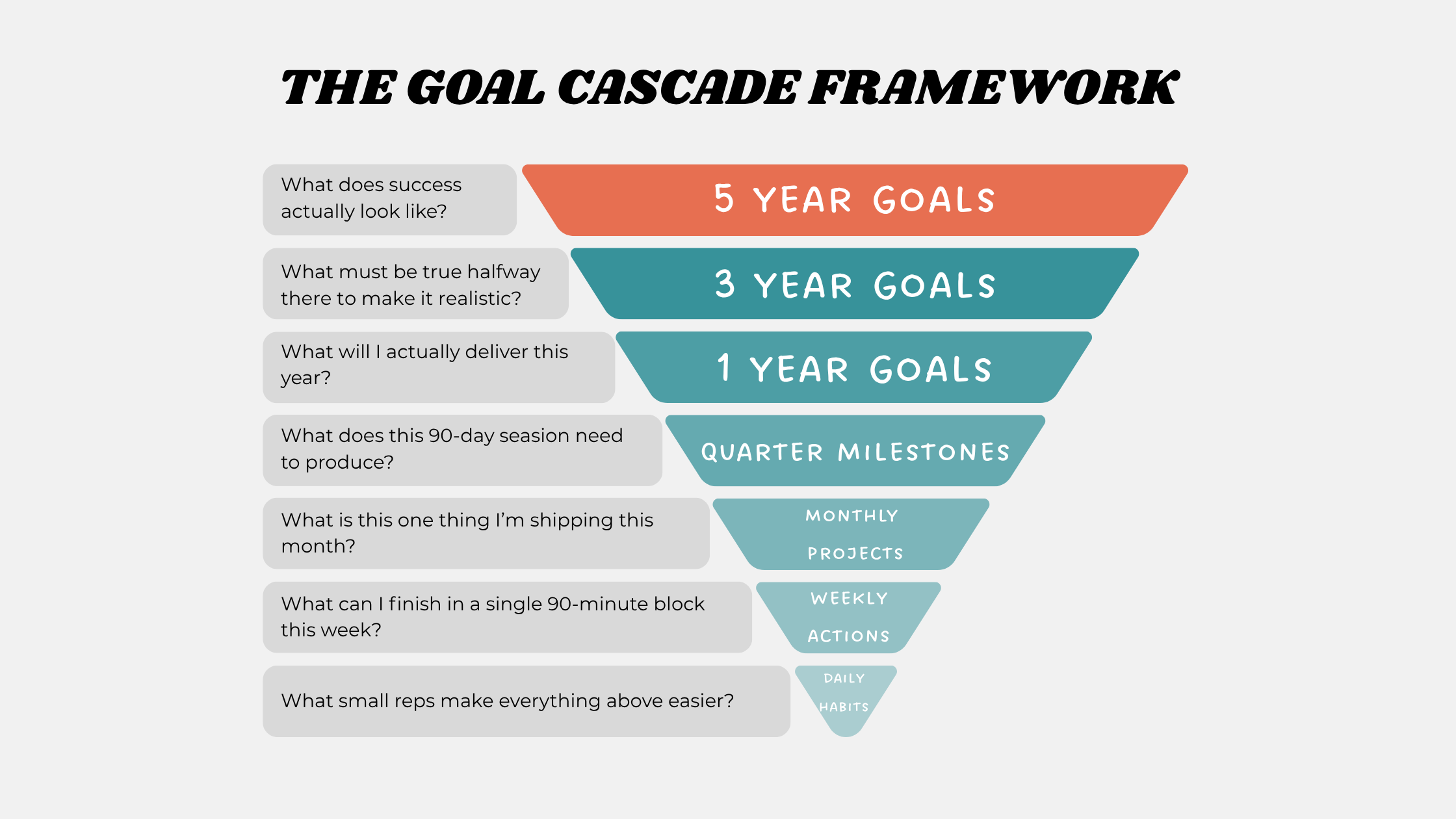
It wasn’t until I started building the Goal Cascade Framework that I understood what had been going wrong — and it wasn’t that I was bad at planning. It was that I’d been approaching the 5-year plan completely backwards.
This series of blog posts is created to accompany the Notion template I created for this framework. I would really appreciate it if you’d check out the template here.
The problem with how most of us set a 5-year plan
Most goal-setting advice starts with the goal. It tells you to dream big, think of where you want to be, and then work backwards. And while the logic isn’t wrong, it skips the most important step: getting clear on what kind of life you’re actually trying to build.
Without that foundation, a 5-year plan is just a wish list. It has no roots. The first time life gets hard or complicated (and it will), there’s nothing anchoring you to it.
What I’ve come to believe (and what the Goal Cascade is built around) is that you can’t set meaningful goals until you know which areas of your life actually matter most to you right now. Not to your parents. Not to the version of yourself you think you should be. To you, today, building the life you’re actively choosing.
That’s what Layer 1 is about.
Start with life areas, not goals
Before I wrote a single goal, I mapped out six life areas that felt genuinely important to me:
- Income & financial independence (anything money/business-related)
- Writing & creative output (self-explanatory)
- Audience building (anything related to social media)
- Health & wellbeing (this also entails my relationships, home, etc. As my wellbeing is definitely dependent on that as well)
- Reading (self-explanatory; it’s own area as I want to put a huge priority on reading diversely and learn from the books I’m reading to hone my craft of writing)
- Skills & knowledge (anything related to new skills I want to learn, or ones I want to maintain. Building out my knowledge on topics that interest me)
These are my six. Yours might look different — you might have relationships, travel, home, or community on yours. The point isn’t to copy mine; it’s to identify your areas. The ones where if nothing were changing or growing, you’d feel it. The ones where progress genuinely matters to you.
Once you have your life areas mapped, the 5-year vision can actually start to take shape — because now you’re not guessing what you want. You’re answering the question for each area specifically.
The SMART goals framework (used properly this time)
You’ve probably heard of SMART goals — Specific, Measurable, Achievable, Relevant, Time-bound. And you’ve probably used them wrong, like I did for years.
The mistake is treating SMART as a filter: you come up with a goal, then you run it through SMART to check if it qualifies. But that’s backwards. SMART is a construction tool. You use it to build the goal from scratch. Let me show you the difference.
Vague version: I want to read more.
SMART version: By March 2031, I read 50+ books per year consistently. That’s the floor, not the ceiling — and it’s been true for at least four consecutive years.
The SMART version gives me something to measure. It gives me a timeline. It tells me what “success” actually looks like. And because I’ve tied it to a life area I genuinely care about (reading as both a joy and a craft tool for my writing), it stays relevant.
For each of your six life areas, you’re going to write a vision like this. Not a sentence — a paragraph or more. The more specific you can be, the more useful it becomes.
What if you don’t know what you want?
This is the most common question I get when I share the Goal Cascade with people, and I want to answer it honestly: I didn’t know exactly what I wanted either.
When I first started building this, my income goal was vague, my writing goals felt terrifying to write down, and my health goals were basically “please be better than this.” That’s okay. You’re not supposed to have it all figured out before you write the vision.
What helped me was asking a different question. Instead of “what do I want in 5 years?”, I asked: “What would I be devastated to look back on and see hadn’t changed?”
That question cuts through the noise. Because the things that would genuinely devastate you to leave unchanged? Those are the things that actually matter.
Start there. Write a messy, uncertain, “I think this is what I want” version. You can refine it. You can change it. The Goal Cascade is a living system — your Layer 1 is allowed to evolve.
Common mistakes to avoid
A few things I learned the hard way while building out my own Layer 1:
Setting goals that sound impressive but don’t excite you. If you write something down and feel nothing, it’s probably not your goal — it’s what you think you’re supposed to want. Rewrite it until it makes you feel something.
Making the vision so safe it requires no real change. A 5-year vision that looks almost exactly like your life today isn’t a vision — it’s a maintenance plan. Your Layer 1 should represent a genuinely different version of your life.
Writing the goals, then filing them away. The 5-year vision only works as Layer 1 of a cascade. On its own, it’s just a document. The magic happens when it connects down to your 3-year plan, your annual goals, your quarterly milestones, all the way to what you do tomorrow morning. (That’s exactly what the rest of this series is about.)
Treating it as permanent. Your 5-year vision will change. Life changes. You change. I review mine every quarter and adjust where needed. The goal isn’t a perfect, unchanging north star — it’s a direction you return to and keep clarifying.
A personal example: my writing goal
Let me show you my full Layer 1 for my writing goal, because I think seeing a real example is more useful than a hypothetical one.
By March 2031 — Writing: I have 6–8 published books in the Greenmont series, plus 2–4 standalone novels and novellas. Combined book sales are 500+ copies/month, generating €2,000–4,000/month in royalties. I’m writing 2,000–2,500 words/day consistently for 12+ months. I’ve received at least 1 award nomination in romance or mystery.
When I wrote that for the first time, my stomach dropped. It felt enormous and impossible. But it also felt true, like the version of this I’d actually be proud of. And that feeling is worth chasing.
I’m not there yet. I’m nowhere near there yet. I’m writing my first novel right now, stumbling through the outline, figuring out my process as I go. But that vision tells me what I’m building towards. And every decision I make about my writing (how much time I give it, what I prioritise, what I’m willing to be bad at for a while) filters through that Layer 1.
How to build your own Layer 1
Here’s the actual process I use:
Step 1: Write down your life areas. Aim for 5–7. Don’t overthink it — what comes to mind when you ask “what parts of my life actually matter to me right now?”
Step 2: For each area, write a “What would devastate me to leave unchanged?” answer. This is your gut check.
Step 3: Build your SMART vision for each area. Use the five-year mark as your target. Write in present tense, as if you’re already there looking back.
Step 4: Read them back and notice how they feel. Adjust anything that sounds like someone else’s goal.
Step 5: Save them somewhere you’ll actually return to. Not buried in a file you’ll never open — somewhere visible, somewhere in your regular workflow.
If you’re using my Goal Cascade Framework template (the Notion template I built for exactly this), Layer 1 is already structured for you. You plug in your life areas and start writing — the architecture of the whole system is there, ready for your goals to live inside.
This is just Layer 1
The 5-year vision is the foundation. It’s the thing that everything else in the Goal Cascade connects back to. But on its own, it’s not enough — which is exactly why this is a series.
In the next post, I’m walking you through Layer 2: the 3-year plan. This is where the long-term vision starts to become something you can actually feel in your daily life — not just something you believe about the distant future.
Because here’s what I’ve found: the 5-year vision tells you what you’re building. The 3-year plan is where you start to believe it might actually happen.