The 7-Layer Planning System I Wish I’d Found Years Ago (Quick Guide)
There’s a version of me from a few years ago who had notebooks full of goals. Big, beautiful, inspiring goals. Vision boards. Highlight-reel ambitions. Or actually, not just a few years ago. It was last year as well..
But I absolutely had no idea how to actually get there.
The gap between “I want to write a novel” and “I am writing a novel” was enormous. And every time I tried to bridge it, I’d either get so overwhelmed by the enormity of it that I’d freeze or I’d get so granular with my to-do list that I’d lose sight of why any of it mattered.
What I was missing was a system that connected the two ends together.
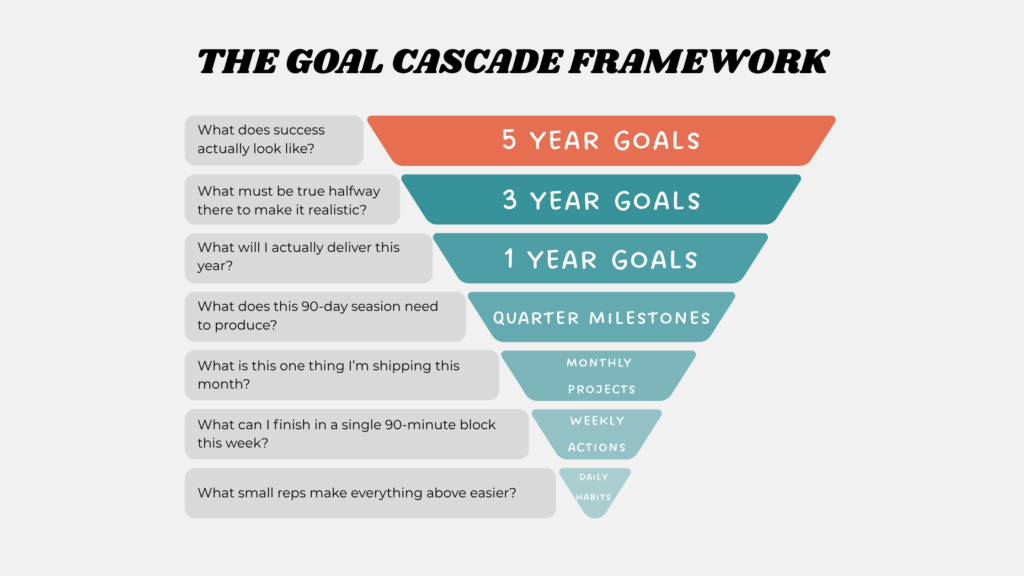
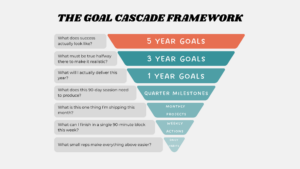
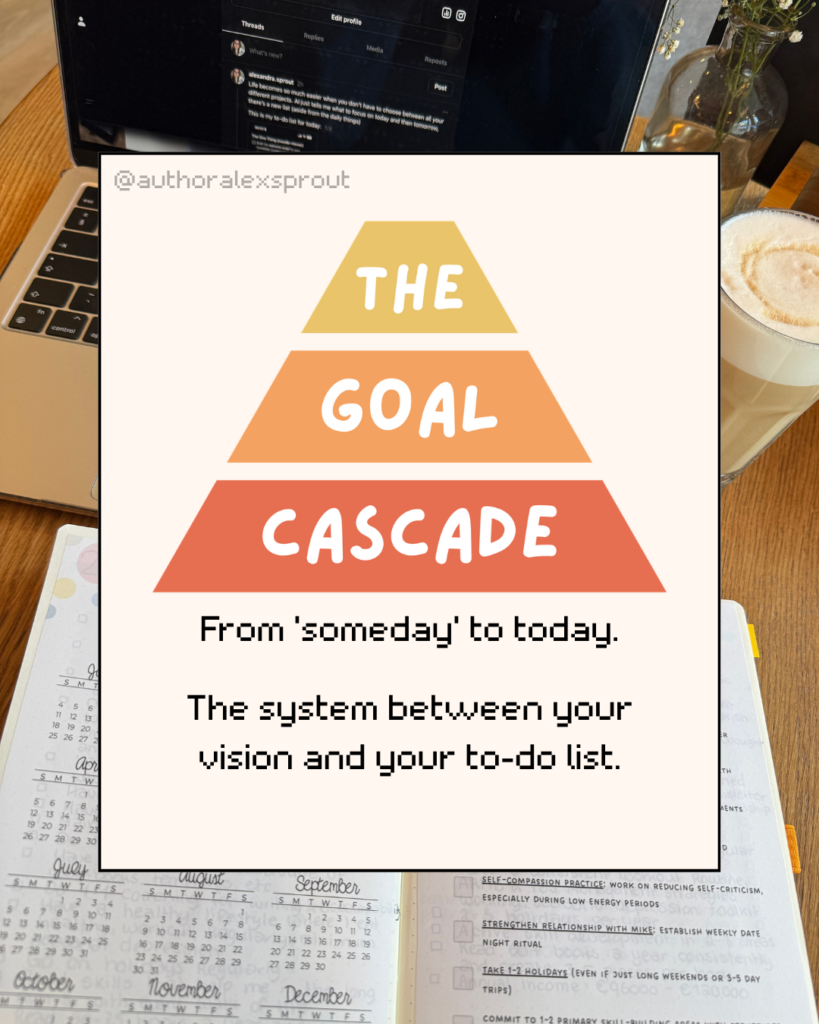
I’ve been building that system for a while now. I call it the Goal Cascade — a 7-layer goal planning system that links your 5-year vision all the way down to the habits you build into your daily routine. And I want to walk you through the quick version of how it works, because honestly? I wish I’d found something like this years ago.
The core idea (before we get into the layers)
Most planning systems work in one of two directions: top-down (start big, cascade down) or bottom-up (start with habits, build up). The Goal Cascade does both, but it starts from a complete picture at the top and works downward in a very specific way.
The logic goes like this:
- Your 5-year goals define what success actually looks like
- Your 3-year goals define what must be true by year 3 to make the 5-year goals realistic (not just hopeful)
- Your 1-year goals define what you’ll deliver this year to advance the 3-year milestones
- Then quarter → month → week → day is where execution lives
Every layer is derived from the one above it. Nothing floats free. Everything connects.
That’s the thing that changed everything for me: when you can trace a single daily habit all the way back to a 5-year vision, the habit stops feeling arbitrary. It has weight. It has a reason.
Layer 1 — 5-Year Goals (SMART, by life area)
This is your north star. Not a mood board. Not a vibe. An actual, scoreable target.
The framework asks you to write one SMART goal per life area; career, health, relationships, finances, creativity, learning, etc. The goal should be specific enough that you could sit down in five years and say, clearly: achieved or not achieved.
The question I use to get there: “If we fast-forward five years, what would make this an undeniable success in each area that matters?”
A few things that help:
- It’s an outcome, not a project list (“earn €8,000/month from my writing business” not “write more, post more, sell more”)
- It’s measurable — you can attach a number, a clear evidence marker, something you can actually score
- It covers your whole life, not just work
This layer is the hardest one to write. It requires you to actually decide what you want, which is terrifying. But it’s also the most liberating part of the system. Once it’s written, everything else gets easier.
Layer 2 — 3-Year Goals (SMART milestones)
Here’s where most people go wrong: they set a 5-year goal and then jump straight to this year’s plan. The gap is too big. You end up guessing.
The 3-year layer exists to close that gap. For every 5-year goal, you ask: “What must be true by year 3 so the last two years are achievable — not a reinvention?”
These are milestone goals. They’re still SMART. They’re still scoreable. But they function as proof points that you’re on the right trajectory.
If you hit your 3-year milestone, the 5-year goal becomes mostly execution, not pivoting.
One rule I follow: the 3-year goal has to be clearly downstream of the 5-year goal. It’s not a separate wish. It’s a specific point on the same path.
Layer 3 — 1-Year Goals (SMART annual outcomes)
Now you’re in territory that feels more familiar. But the key difference with this system is that your annual goals are derived, not dreamed up fresh.
You’re not asking “what do I want this year?” You’re asking: “For each 3-year milestone, what’s the best next 12-month step that we can actually deliver?”
That word “deliver” matters. These aren’t intentions. They’re outcomes you can evidence at year-end.
A few guardrails I use:
- If a life area isn’t a focus this year, I define a maintenance standard (minimum viable progress) instead of a full annual goal
- Every 1-year goal has to clearly trace back to the 3-year milestone it came from
- It has to fit real capacity — your actual calendar, energy, and constraints, not the fantasy version of yourself
Layer 4 — Quarterly Milestones
The quarterly layer is where long-term planning meets real-world execution. This is your 90-day “season.”
For each of your life areas, you derive a quarterly milestone from the 1-year goal it came from. The question per area is: “What must be true by the end of this quarter so that the annual outcome stays on track?”
The most important thing about this layer: they’re written as end states, not intentions. Not “work on product launch.” Instead: “Product live with first sales by end of quarter.”
If those are done, the quarter is a win — even if everything else slips.
I also keep a “Someday/Maybe”-list on this level. If an idea were to come up that I’m really excited about, I park it on this list and I get to choose from this list during the quarterly review (more on that later!). The current quarter is planned, don’t need to overwhelm myself by adding something new and shiny. It would just lead to burnout.
Layer 5 — Monthly Deliverables
Each month, you pick one deliverable that advances a quarterly milestone.
One. Not five. One.
The test I use: is it binary? Can you say, on the last day of the month, “shipped” or “not shipped”? If yes, it’s a good monthly deliverable. If it’s fuzzy — if it’s a process, not a product — it needs to be sharpened.
A deliverable might seem a bit weird in relation to for example your life area of (mental and/or physical) health. But I consider “workout 3 times a week” a deliverable, especially when you have a workout partner. You can show for it that you actually did the thing. Or building the habit of journaling. Make it quantifiable by saying “journal 5 days a week for 5 minutes”. You can show to anyone (or just yourself) whether you have done that.
Layer 6 — Weekly Commitments (90-minute blocks)
This is the layer that changed how I think about tasks entirely.
A weekly commitment must fit in one focus block of 90 minutes or less — including setup and wrap-up. If a task would take longer, it’s not a weekly commitment yet. Break it down.
This rule forces honesty. Most “tasks” on our to-do lists are actually projects. They’re too big to commit to in a single sitting. When you force yourself to define things at the 90-minute level, you stop kidding yourself about what’s actually doable in a week.
Each week, I aim for 3–7 of these commitments. Each one:
- Has a clear deliverable (not just “work on X”)
- Has evidence of done
- Is preferably calendared to a specific day and time
I also define a Minimum Viable Week: the smallest set of commitments that keeps momentum alive, even if energy tanks. Usually 1–2 must-ship blocks + daily habit reps.
Layer 7 — Daily Habits
The bottom of the cascade. The reps.
Daily habits in this system have one job: make the weekly deliverables easier to complete. They’re not general self-improvement. They’re tied to the current quarter.
Each habit gets a minimum version: what’s the smallest version that still counts on a bad day? That’s the non-negotiable floor. The ideal version is what you aim for when you have the energy.
Tracked as yes/no, or a simple number. Nothing complicated.
The minimum version is the thing that saves streaks, prevents the spiral of guilt, and keeps the whole system alive when life gets hard.
The glue: Reviews
The system only works if you close the loop. Reviews are built into every horizon:
- Daily (2–5 min): confirm today’s actions, track habit minimums, identify the next visible step
- Weekly (15–45 min): score deliverables, decide next week’s commitments, identify the bottleneck
- Monthly (30–90 min): score the monthly ship, choose the next month’s deliverable
- Quarterly (60–120 min): score milestones, re-select next quarter’s 1–3 priorities
- Annual (half-day): score 1-year outcomes, choose next year’s goals
Without reviews, the cascade drifts. With reviews, it recalibrates.
Why this clicked for me
I’ve tried a lot of planning systems. Some were too abstract (hello, annual goals that lived in a notebook and never got touched again). Some were too granular (task managers with hundreds of items and zero sense of direction).
The Goal Cascade is the first thing that made me feel like my daily habits were actually doing something. Like the small, unsexy daily reps were connected to something real.
There’s a simple test I run now when I’m deciding whether to do something:
“If this is done, what changes in reality?”
If I can trace an honest answer to that question — through the weekly → monthly → quarterly → annual → 3-year → 5-year chain — I do it. If I can’t, I don’t.
That’s the system in a nutshell.
I’m still learning how to run it well. I’m still figuring out what works during the hard months, how to adjust when life derails the plan, how to hold the long view without losing sight of today. But having the structure? That’s changed everything.
If you want to dig into the full framework, I’ve put it all together in the Goal Cascade Framework Template. See if it clicks for you.
For each of the layers, I will be posting a full blog post to guide you through each. So stay tuned for that this upcoming week!
Currently building this system in public — following along on Threads and Instagram if you want to see what it looks like in real life, not just on paper.
Want to know more about me? You can find that here.